
Sculptural Gold Rings for Women: The Ultimate Guide
Table of Contents
- What Makes a Sculptural Gold Ring Different
- How to Style Statement Rings for Everyday Wear
- Stacking Sculptural Rings: A Practical Guide
- Caring for 14k Gold Rings and Vermeil Pieces
- Handcrafted Gold Jewelry Benefits: Why Process Matters
- Choosing the Right Ring Size and Metal
- Conclusion
- Frequently Asked Questions
Last Updated: September 27, 2026
What Makes a Sculptural Gold Ring Different
A sculptural gold ring is a piece of jewelry where the form itself carries the design, rather than a setting built around a single stone. These rings favor curved planes, folded metal, and irregular silhouettes over traditional symmetry.
This guide from dani keith designs jewelry covers how to choose, style, and care for sculptural gold rings for women who want jewelry that reads as intentional rather than mass-produced. The category has moved from gallery cases into daily wardrobes, and for good reason: a bold silhouette does more visual work than a delicate band ever can.
Anatomy of a Sculptural Ring
Every sculptural ring has three working parts, and understanding them changes how you shop.
- The shank: the band that wraps your finger. On sculptural pieces it is often asymmetric, widening at the face or twisting along its length.
- The face: the raised or widened area that carries the design. This is where volume, negative space, and texture live.
- The transition: the join between shank and face. A well-made transition is smooth and reinforced; a rushed one is where rings fail first.
Most shoppers never look at the transition. It is the single best place to judge whether a piece was built to last.
Organic Forms and Abstract Designs
Organic forms mimic nature: uneven edges, softened curves, shapes that look grown rather than drawn. Abstract designs pull from architecture and modern art, using sharp angles, folded planes, and geometric shapes.
Neither style is more sophisticated than the other. The real question is which one suits how you dress. Organic shapes soften structured tailoring; abstract shapes sharpen soft, flowing clothing.
How to Style Statement Rings for Everyday Wear
Styling statement rings for daily wear comes down to one rule: let the ring be the loudest element in the outfit. Everything else should support it.
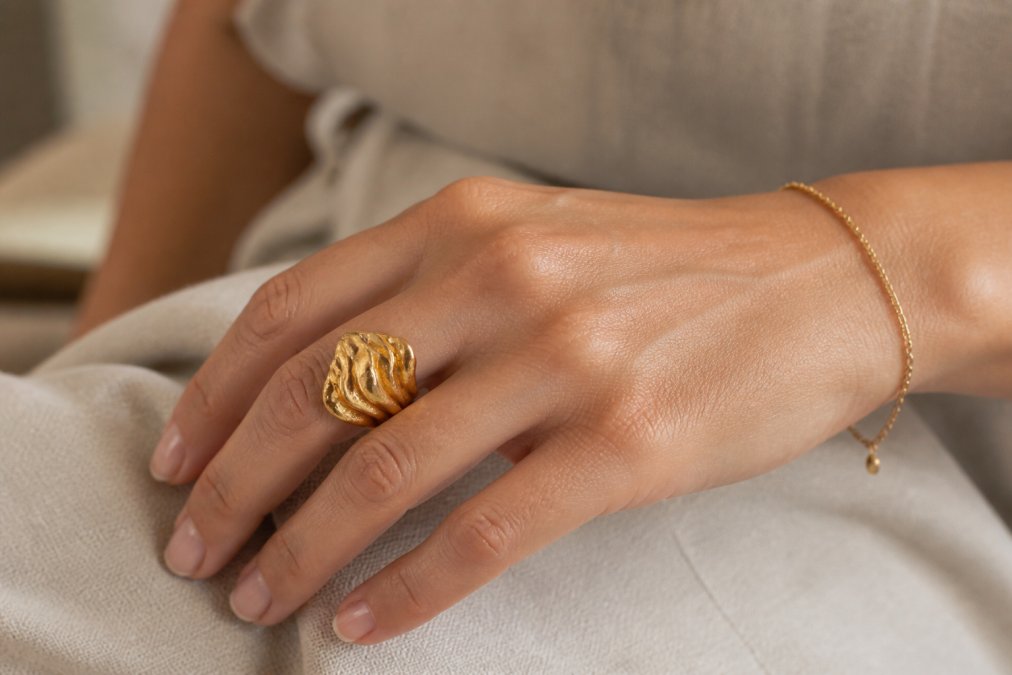
Start with a plain base. A solid knit, a crisp button-down, or a monochrome dress gives a sculptural piece room to register. Busy prints compete with the ring and flatten its impact.
For hands, keep the rest of the jewelry quiet. Skip chunky bracelets on the same arm. If you wear earrings, choose small studs so the eye travels to the ring instead of bouncing between focal points.
Face Shape and Hand Anatomy Styling
Hand anatomy matters more than most guides admit, and it is the single most useful filter for narrowing a sculptural ring shortlist. Rather than guessing from product photos, measure three things: finger length (base of finger to tip), finger width at the widest knuckle, and the length of your palm relative to your fingers.
Finger length. Long fingers (roughly 3.5 inches or more from base to tip) carry wide, flat faces and oversized silhouettes without looking weighed down. Short fingers usually look better in rings that rise vertically rather than spreading sideways, a tall, narrow face elongates the finger visually, while a wide horizontal face compresses it.
Finger width. A wide face on a wide finger reads as a solid block; the same face on a narrow finger reads as a deliberate statement. If your fingers are on the wider side, look for faces with negative space cut into them, open centers, hollowed curves, split shanks, so the ring reads as sculptural rather than heavy.
Knuckle profile. Wider knuckles need tapered shanks that slide over the joint easily and sit securely below it. A shank that is the same width all the way around will either be too tight at the knuckle or too loose at the base. This is one of the most common fit failures on sculptural rings, because the wide face draws attention away from the shank geometry.
Face shape. Angular features pair naturally with geometric shapes; softer features pair with organic curves. This is a subtler effect than hand anatomy and should not override comfort or personal preference.
- Long, slender fingers: wide bands, oversized faces, stacked sets
- Shorter fingers: elongated silhouettes, single bold rings, narrower shanks
- Wider knuckles: tapered shanks, open or hollowed faces
- Narrow fingers: bold horizontal faces, chunky bands
Occasion-Based Styling
The same ring can read as office-appropriate or evening-bold depending on what surrounds it.
Work. Pair a single sculptural ring with a plain band on the opposite hand. Keep the rest of the jewelry minimal, one pair of small studs, no bracelet on the ring hand.
Stacking Sculptural Rings: A Practical Guide
Stacking works when each ring in the set has a clear job. Treat the stack as one composition, not three separate purchases.
| Stack Position | Ring Type | Purpose |
|---|---|---|
| Base (closest to knuckle) | Thin plain band | Grounds the stack |
| Middle | Textured or twisted band | Adds visual interest |
| Top | Wide sculptural ring | Creates the focal point |
Caring for 14k Gold Rings and Vermeil Pieces
Caring for 14k gold rings is simpler than most people expect. Solid gold resists tarnish and tolerates daily wear; the main enemies are scratches and chemical exposure, not time.
- Remove rings before cleaning with household products, swimming, or applying lotion and perfume
- Store pieces separately in soft pouches so harder metals do not scratch softer ones
- Clean with warm water, a drop of mild soap, and a soft brush, then dry with a lint-free cloth
What Karat Actually Means for Wear
Gold purity is measured in karats, and the number tells you how much of the alloy is gold versus other metals. 24k is pure gold, too soft for everyday rings. 18k is 75% gold, 14k is about 58%, and 10k is about 42%. The remaining metal is a mix of copper, silver, zinc, or palladium that gives the ring its hardness and color.
Vermeil: How It Wears and When It Fails
Vermeil needs more attention. 18k gold vermeil is a thick gold layer over sterling silver, and it can wear through at high-friction points if treated roughly. The legal threshold in the United States is a gold layer of at least 2.5 microns over sterling silver (925), anything thinner is technically gold-plated, not vermeil. The FTC guidance on gold and vermeil labeling explains what these terms legally mean, which helps you compare pieces honestly.
Where Your Gold Comes From
Most jewelry guides stop at cleaning. The origin of the gold matters just as much as the karat stamp, and it is the question more buyers are asking.
Handcrafted Gold Jewelry Benefits: Why Process Matters
Handcrafted gold jewelry benefits show up in details that machine production cannot replicate. A hand-forged ring carries small variations in thickness and surface, and those variations catch light differently than a uniform cast piece.
Choosing the Right Ring Size and Metal
Getting ring size right matters more with sculptural pieces because a wide face fits tighter than a thin band of the same size. Measure your finger at the end of the day, when it is at its largest, and size up half a size for rings wider than about 6mm.
Metal choice comes down to wear pattern and budget:
- 14k gold: durable, tarnish-resistant, good for everyday rings and engagement pieces
- 18k gold vermeil: sterling silver with a thick gold layer, offers the gold look at a lower cost
- Sterling silver: a cooler tone, softer metal, best for occasional wear
Conclusion
Choosing sculptural gold rings for women is really a question of how you want to show up. The right piece should feel like yours, not like something pulled from a display case.
Frequently Asked Questions
What defines a sculptural ring?
A sculptural ring is jewelry treated as a three-dimensional form rather than a flat band with a stone. It features organic forms, abstract designs, or geometric shapes that create volume and shadow. Hand-hewn sculptural gold rings often show tool marks and irregular edges that mass-produced cast pieces lack. The silhouette matters more than the sparkle, which is why these rings read strongly on camera and in person.
Are sculptural gold rings suitable for daily wear?
Yes, with the right construction. Solid 14k gold and 18k gold vermeil over sterling silver hold up to daily wear far better than thin gold plated pieces. Look for smooth interior finishes and comfortable band widths. Handcrafted gold jewelry benefits include reinforced joints and thoughtful weight distribution, so a sculptural ring can be worn every day without feeling fragile or catching on clothing.
How do you style bold gold rings with everyday outfits?
Keep the rest of your jewelry minimal and let one sculptural gold ring lead. Pair it with a plain turtleneck, a crisp button-down, or a monochrome outfit so the ring becomes the focal point. For how to style statement rings at work, choose a single dramatic silhouette on the index or middle finger and skip the bracelet stack. The contrast between simple clothing and a bold ring reads intentional rather than busy.
What is the difference between cast and hand-hewn gold jewelry?
Cast jewelry is poured into a mold, producing identical copies with smooth, uniform surfaces. Hand-hewn pieces are shaped directly from metal with tools, so each ring carries slight variations in texture, weight, and curve. That irregularity is the point. Handcrafted gold jewelry benefits include a one-of-a-kind profile, stronger solder joints in many cases, and a tactile finish that catches light differently than a polished cast surface.